Last updated July 2026
You built the thing. The farm, the shop, the service, the restaurant. You did the hard part.
And then you typed your own business into Google, half-expecting to see yourself right there at the top, and instead you got three other businesses you’ve never heard of, a map you’re not on, and a slow, sinking feeling that something is wrong.
Here’s the direct answer: your business isn’t showing up on Google because one or more of five things is broken, your Google Business Profile, your website’s local signals, your reviews, your content, or the basic consistency of your business information across the internet. It’s rarely one catastrophic mistake. It’s usually a handful of small gaps that, together, tell Google (and increasingly, AI search tools) that your business isn’t the safe, obvious answer to the search someone just typed.
The good news is that none of those five things are mysterious. They’re fixable, in order, starting today. That’s what the rest of this article walks through.
Key Takeaways
- 46% of all Google searches carry local intent, and most of those searchers act within 24 hours…if you’re invisible, you’re losing customers who were already looking for you.
- Your Google Business Profile is doing more work than your website right now. It’s the first thing most local customers see, and an incomplete one quietly disqualifies you.
- Businesses that show up in Google’s top three local results capture dramatically more traffic and customer actions than everyone else on the page, there’s no reward for being “pretty good.”
- Local SEO isn’t a checklist you finish once. It’s the ongoing coherence between what Google knows about you, what your website says, and what’s actually true about your business.
- AI tools like ChatGPT are becoming a real local discovery channel, and most businesses aren’t set up to be found there either.
The Problem: You Did Everything Right, and You’re Still Invisible
This is the part that feels unfair. You have a real business. Maybe a beautiful website. Maybe a loyal customer base built over years of showing up and doing good work. And none of that guarantees Google will show you to the person searching three miles away, right now, for exactly what you sell.
We’ve sat across the table from business owners who felt this exact frustration, sharp people who built something real with their hands and their reputation, only to watch a newer, less-established competitor show up first because that competitor happened to get the technical side right. It’s not a talent gap. It’s not a hard-work gap. It’s an information gap: Google can only recommend businesses it can clearly understand, verify, and trust. If your online presence is incomplete or inconsistent, Google has no way to know you’re the right answer, even when you obviously are.
That’s the part worth sitting with before we get tactical: local SEO isn’t about tricking an algorithm. It’s about making sure the truth about your business is actually visible to the systems deciding who gets recommended.
The Evidence: What’s Actually Happening in Local Search Right Now
Local search isn’t a nice-to-have marketing channel anymore. It’s the primary way people find local businesses, and the data backs that up clearly.
Nearly all consumers now search online before they ever visit or contact a local business, and that number has climbed steadily over the past several years as “just Google it” became automatic behavior for even the most routine purchases. Search itself has followed: a 2026 study from Think with Google found that searches including “near me” have grown significantly in the last decade, with more than 200 million monthly “near me” searches recorded in early 2026. Nearly half of everything typed into Google now has a local angle to it, and those searches convert fast, most people who search for something nearby take action, whether that’s a call, a visit, or a purchase, within a single day.
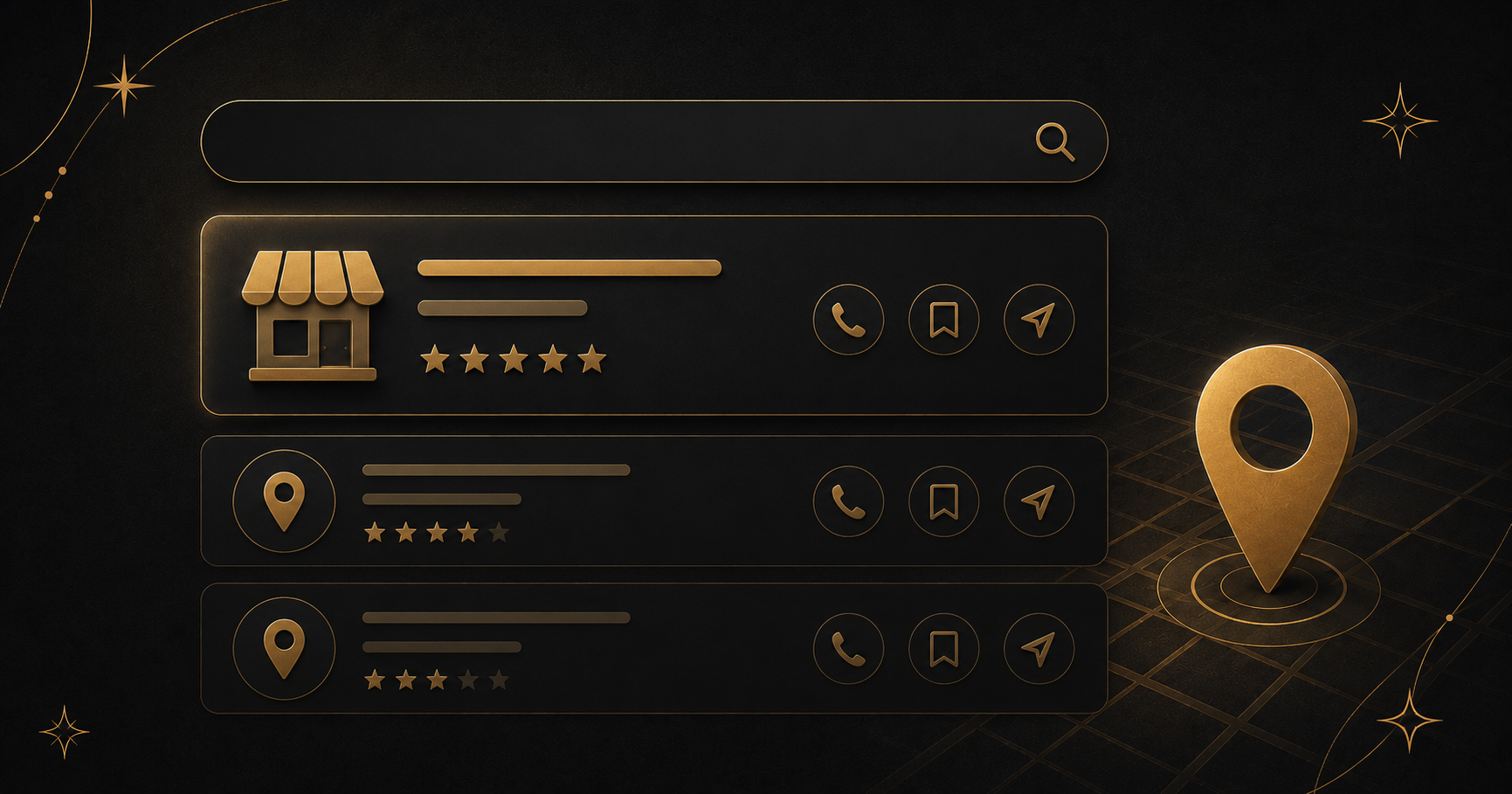
Where you land on the results page matters enormously. According to First Page Sage’s 2026 click-through data, businesses that appear in Google’s local three-pack (the map and three listings at the top of local results) capture 126% more traffic and 93% more conversion-oriented actions than businesses sitting in positions four through ten. There’s no partial credit here. Either you’re in that top cluster, or you’re fighting for scraps below it.
Your Google Business Profile carries more weight than most business owners realize. Google’s own data shows customers are 2.7 times more likely to trust a business with a complete profile, 70% more likely to visit, and 50% more likely to make a purchase. Birdeye’s 2026 State of Google Business Profile report adds a sharper edge to that: verification is now a standard requirement for visibility, with 76% of businesses verified in 2025, up from 71% in 2024, and unverified profiles increasingly lose visibility and miss high-intent customer actions. Meanwhile, brands with verified profiles generate up to 4 times more website visits and double-digit increases in calls and direction requests compared to unverified ones.
Consistency matters just as much as completeness. A 2026 DreamHost analysis of 230 local businesses found that 53% had mismatched information between their Google Business Profile and their website, different hours, different phone numbers, different addresses. That inconsistency doesn’t just confuse customers; it actively signals to Google that your listing might not be reliable.
And the ground is shifting again. Generative AI tools are becoming a real local discovery channel in their own right. Recent BrightLocal research found that a growing share of consumers now use ChatGPT or similar AI tools when looking for local recommendations, and separate research from SOCi found that visibility in AI-generated local recommendations is far harder to achieve than ranking in Google’s traditional local results, with less than half of businesses that lead in Google local search also appearing in AI recommendations. Being findable on Google is no longer the whole assignment. Being findable, described accurately, and recommendable by AI systems is the new bar.
The Reframe: Local SEO Isn’t a Checklist. It’s Coherence.
Most local SEO advice treats this like a technical scavenger hunt: claim your listing, add some keywords, get a few reviews, done. That advice isn’t wrong, exactly. It’s just incomplete, and it’s why so many business owners do “the SEO stuff” once and then wonder why nothing changed six months later.
Here’s the reframe we build every client’s strategy around: Google, and increasingly AI search, aren’t ranking your keywords. They’re evaluating whether your business is what it claims to be. They cross-reference your Google Business Profile against your website against your reviews against how consistently your business shows up across the internet, looking for agreement. When everything lines up, same hours, same services, same voice, same story, told consistently everywhere a customer might encounter you, that’s what we call coherence. And coherence is what earns trust from an algorithm the same way it earns trust from a person.
This is the opposite of the “post more, do more, buy more ads” advice that leaves so many local business owners exhausted and no more visible than when they started. You don’t need to do more. You need everything you’re already doing to actually agree with itself.
The Solution: Building Coherent Local Visibility
Fixing local visibility starts with treating your online presence as one connected system instead of a pile of separate tasks. In practice, that means your Google Business Profile, your website, your reviews, and your content all need to tell the same accurate, complete story about who you are and what you do, and that story needs to be easy for both a human and an algorithm to verify at a glance.
We’ve watched this play out with clients who came to us feeling invisible online despite doing solid, honest work for years. The fix was rarely “do something dramatic.” It was closing small gaps: a Google Business Profile that hadn’t been touched since it was created, a website whose service pages didn’t match what the business actually offered anymore, hours that were wrong on three different platforms. Once those gaps closed and the story became consistent everywhere, visibility followed. Not because we tricked Google. Because we gave Google, and the customers searching on it, something coherent to find.
That’s also why we don’t sell local SEO as a one-time fix. Search behavior keeps shifting, your business keeps evolving, and coherence is something you maintain, not something you achieve once and forget.
Where to Start: Five Steps to Take This Week
- Claim and verify your Google Business Profile if you haven’t already. If you’re not sure whether it’s claimed, search your business name on Google and look for an “Own this business?” prompt. An unverified or unclaimed profile is invisible to the algorithm no matter how good your business is.
- Audit your profile against your website for consistency. Open your Google Business Profile and your website side by side. Check your hours, phone number, address, and service list line by line. Fix any mismatch you find today, this is the single fastest trust signal you control.
- Fill in every field on your Google Business Profile, not just the required ones. Add your business description in plain, human language, select every relevant category, list your specific services, and upload real photos of your actual location, team, and work. Complete profiles consistently outperform partial ones.
- Ask your last five happy customers for a Google review, this week. Don’t wait for reviews to happen organically. Send a direct text or email with a link. Recent reviews carry more weight than old ones, and a steady trickle of fresh reviews signals an active, trustworthy business.
- Make sure your website actually says what you do, in words your customers would use. If your homepage is all brand language and no plain description of your services and service area, both customers and search engines are guessing. Say what you do, where you do it, and who it’s for, in the first few lines.
- Check your listing consistency across the other platforms customers actually use. Yelp, Facebook, Apple Maps, and industry-specific directories all feed into the same trust picture. Pick your three most important ones and confirm your information matches everywhere.
- Publish one piece of content that answers a real question your customers ask. It doesn’t need to be long. It needs to be true, specific, and genuinely useful. This is where your website starts building the topical authority that keeps you visible long-term, not just after a one-time cleanup.
Frequently Asked Questions
How long does it take to start showing up on Google after fixing these issues?
Google Business Profile improvements can show results within a few weeks, since Google re-crawls active profiles frequently. Website and content changes take longer, often two to four months, because search engines need time to recrawl and reassess your site’s authority on a topic.
Do I need a blog to rank locally, or is my Google Business Profile enough?
Your Google Business Profile is the fastest lever, but it has a ceiling. Sustained visibility, especially against competitors doing the same GBP basics, comes from a website that consistently demonstrates real expertise through content. Think of GBP as the front door and content as what proves you belong there.
Why does my competitor rank higher when their business isn’t as good as mine?
Ranking reflects what Google can verify, not what’s actually true about service quality. A competitor with a more complete profile, more consistent information, and more recent reviews will often outrank a better business that hasn’t done that groundwork. This is fixable, and usually faster than people expect.
Does posting on social media help me show up on Google?
Indirectly. Social media doesn’t feed Google’s local ranking algorithm directly, but it drives traffic, generates reviews, and builds the kind of consistent, active online presence that supports every other local SEO signal. Treat it as reinforcement, not a replacement for GBP and website work.
Is it worth paying for Google ads if my organic local visibility is weak?
Ads can create visibility while you fix the underlying issues, but they’re a rental, not an asset. Money spent on ads produces nothing once you stop paying. Time spent fixing your Google Business Profile, website, and reviews builds visibility that keeps working for you indefinitely.
The Close
The gap between “invisible” and “the obvious choice” is usually smaller than it feels from where you’re standing. It’s not a talent problem, and it’s not a hard-work problem. It’s a handful of small inconsistencies between what’s true about your business and what Google can actually see.
Close those gaps, and something interesting happens: you stop chasing visibility and start simply being found, by the people who were already looking for exactly what you built. That’s the whole goal. Not more noise. Just the truth about your business, showing up where it was supposed to be all along.
Keep Learning
- How Do I Optimize My Google Business Profile to Actually Get More Calls? (HERE)
- Do I Need a Custom Website, or Will a Template Work for My Small Business? (publishing soon)
- How Often Should a Small Business Actually Post Content to See Results? (publishing soon)
- What Makes a Customer Choose One Local Business Over Another Just Like It? (publishing soon)
Ready for an honest look at where your visibility gaps actually are? Get your free marketing audit
About the Author
Jamy is co-founder of Rogue Sisters Marketing, where she and Sarah Librada build websites, local SEO strategy, and marketing systems for farmers, restaurants, shops, and service businesses across Eastern Iowa. Rogue Sisters Marketing is the implementation arm of the Rogue Sisters Foundation and operates on the belief that marketing should generate energy for a business, not drain it.